
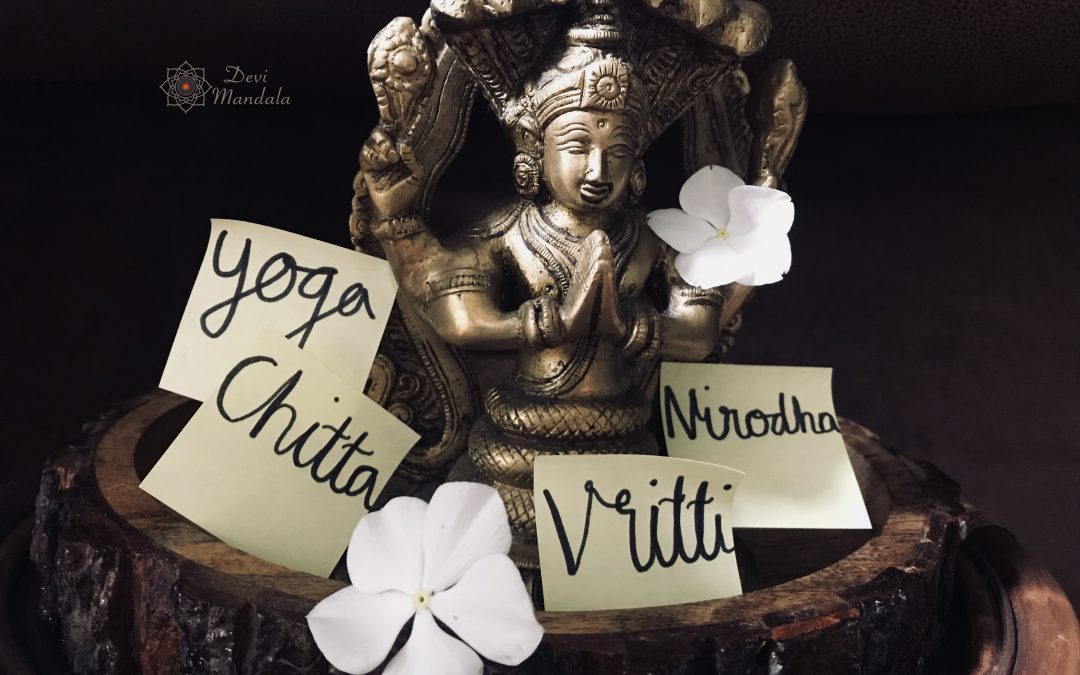
Yoga: the biggest craze at this moment. Moment: Atha, now. Maharishi Patanjali will be so happy that yoga is in the moment, now!
So many of us are training to become Yoga Teachers. The world wants to learn yoga. So the obvious question we need to ask ourselves is, what is Yoga?
Is it just the pose or the asana, or is it the whole paraphernalia of the yoga pants and monogramed t-shirts, the beads and the incense and the Instagram posts or is yoga more than that.
Maharishi Patanjali, who so humbly calls himself the compiler not the originator of the Yoga sutras, the holy grail of yoga pours pure and absolute wisdom through his thread of poetry called the sutras, each sutra contains a world of wisdom. He is a master of the mind. No one has understood the mind better than Maharishi Patanjali did. In the yoga sutras, he lays the foundation of what is the mind and how to overcome human affliction. Giving us a glimpse into the possibilities of human experience and transcendence, he defines yoga in his second sutra from chapter 1, where he says: Yogaschitta vṛtti nirodhaḥ.
Yoga is the cessation of the mental afflictions or modifications of the mind.
To understand this sutra is to understand the purpose of human experience.
Chitta, loosely known as the chitta complex, contains the buddhi (intellect), aham (ego) and mind (manas). Imagine the chitta complex to be the city from the movie Inception, where Dom is seen roaming in. It’s his city (chitta) consisting of buildings of his memories. Each building contains some information from his past. Our chitta is like that city with buildings containing information about our personality, about ourselves, our memories, emotions, our samskaras. Samskaras are our predisposition to reacting to a given reality or situation.
So chitta can be seen as this container, containing information and our cognitive responses. “It contains the conscious, the subconscious and the unconscious”, says Swami Satyananda Saraswati.
Master Osho relates a beautiful story of a sage who was once visited by an emperor who was troubled by his mind. “ I have come to you so you can put my mind at peace”, said the emperor. The sage very tenderly asks him to come meet him the next day and reminds him not to forget to bring his mind with him. When the emperor visits the sage the next day, he is once again questioned if he brought his mind with him and the emperor who was rather miffed by then, replied that his mind is always with him, inside him and there was no question of forgetting his mind.
The sage smiled and said, “well wonderful that we know your mind is inside of you. Now show me the location.” The emperor sat in contemplation searching for the location and realised that there is no mind. There is only activity.
The mind is an activity! This activity is the vrittis. Vriita is a circle and vrittis are circular movements inside our chitta. They are constantly causing ripples and movement. Instead of asking what these ripples are maybe we need to understand why these ripples are created.
This activity is the play of the gunas. According to samkhya philosophy, the three gunas of sattva, rajas and tamas are what make up nature or prakriti. They are present in every matter and have specific characteristics. They are also present in our chitta or mind creating different levels of mind known as chitta bhoomis.
Tamas guna characterized by inertia as present in the mineral kingdom, creates a state of dullness and laziness which is called a mudha state in our mind.
Rajas guna characterized by activity as present in the animal kingdom which is so primal and reactive creates a state of hyperactivity known as kshipta state.
Sattva guna is a state of balance and calm. But getting to that state the mind travels through an intermediary state called vikshipta, where we oscillate between activity and calmness.
As humans we have the power of choice, the power to reason. But for the most part we find ourselves reacting instead of responding. This act of reaction is what causes karma (action in thoughts, words and deeds). Our physical body serves just as a vehicle to carry out action through our senses of action and perception. The mind carries it further with reaction. But when one digs deeper, we see that there is a controller behind this all. It is our samskaras. Our samskaras are our reason behind our reaction and action. And we are constantly caught up inside this vicious cycle of reason, reaction and action.
It is here that Maharishi Patanjali gifts us his path of yoga. Comforting us, he assures us that if we follow his path with utmost sincerity (abhyaas) and detachment (vairagya) there is hope. He says that at the vikshipta state as we are slipping down towards kshipta or mudha state, discipline (tapa) and swadhyaya ( inner reflections and contemplation) will serve as our anchor holding us back in our sadhana. Through swadhyaya we constantly question ourselves, are we reacting or are we responding to our situations. Are we creating more karma or are we surrendering and accepting the effects of our past karma?
In following tapa and svadhyaya, he is helping us encourage and promote the sattva guna inside us. He gives us many paths, asana, mantra japa (pranava japa), anything that will bring our focus to one point, leading us towards the state of Ekagrata. This is the state of one pointed focus.
But focus involves the mind again. And the word focus feels so restrictive, like a constraint. But Patanjali reminds us that if vikshipta state involves activity of tapa and svadhyaya, in ekagrata he urges us to surrender to the divine.”Īśvarapraṇidhānādvā”. This is not a state of doing but rather a state of being or a state of allowing.
And what happens after? Master Osho gives a beautiful analogy of the flow of a river. He says, “how do we stop the flow of the river? We cannot”. He says “the flow of the river is because of momentum. When momentum ceases, the flow will eventually stop.” And so it is with the flow of our chitta vrittis. The momentum is coming from our samskaras. In the state of ekagrata, we have stopped our reactions and our responses, slowing down our karmas. Eventually in time the river will stop.
When, you ask?
A dear friend and a wise soul, reminded me of a beautiful poem by the great Indian poet Kabir. Says Kabir,
“Dheere Dheere Re Mana, Dheere Sab Kucch Hoye
Mali Seenche So Ghara, Ritu Aaye Phal Hoye”
“Slowly slowly O mind, everything in own pace happens
Gardener may water with a hundred pots, fruit arrives only in its season.”
Maharishi Patanjali says surrender to the divine. In time all the samskaras will exhaust, all activity will slow down. There will come a state of no experiences. And when finally there is no activity, no experience, you will reach the state of “niruddha”. There will only be awareness.
That is the state of Yoga. That is yoga chitta vritti nirodha. And in that moment, the Purusha or the seer will establish himself within. Tadā draṣṭuḥ svarūpe’vasthānam
We will all one day get here. As teachers we need to correct our status. We should call ourselves eternal students (sadhakas) of yoga. Let us earnestly and with complete eagerness just follow our study (abhyasa) with tapa and svadhyaya and complete detachment (vairagya). In time, the teacher within will awaken and use us as a channel for his or her instructions.
We need to remind ourselves that we are not teachers, we are just channels. As students or sadhakas of yoga, may we continue on this journey inwards awakening the light within us and spreading the light of yoga outside and everywhere.
It require discipline to do svadhyaya..
Openeness and surrender to learn and grasp and experience what u have done
And a deep sense of reverence to the eternal wisdom..
Truly a student for life .. Beautiful is your mind
Beautiful is your journey and blesses are we to have crossed paths
Love the way the website is built and the cleaner look of it. Looking forward to reading the articles and learn the connection between yoga and our daily lives.
I want to get one step closer to living a joyful life.
How beautifully you have summed up the essence of swadhyaya ,samskaras and ultimately surrendering to the divine….
Just the way you are ….Beautiful inside out…
Beautiful article.
Yoga philosophy is very well explained . As we have four limbs to perform actions in the outer world same way there are four aspect of inner world- buddhi, manas, ahamkara and chitta . You have explained the inner world and it’s functions beautifully at the same time very simply too.
This article shows that there is lots of clarity ,about the subject , in the mind .
By contemplation one can experience the thought process , it’s origin and effects . That will help to choose the correct technique to live the philosophy of this great science called *YOG* .
Thanks for sharing this article .
Regards
Thank you for such a lovely comment Kalpana Ma’am. Coming from you, my Guru, this is equivalent to receiving an oscar. But then again, Yog teaches me that this is also an attachment or Raaga :-). Thank you for sharing your words of wisdom as well. If I’am a thirsty seeker, then you are that well that is ever flowing with the wisdom of YOG. It is truly a Blessing to learn from you. Its what can be called as GuruKrupa. Reverent Bows!!